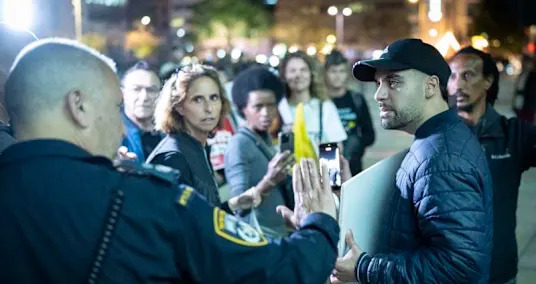
Protests took place in Tel Aviv, Jerusalem, Haifa, and Beersheba, as a survey found broad but uneven support among Jewish Israelis for Operation Roaring Lion.
Israel Police arrested 21 anti-war protesters Saturday night as demonstrations against the conflict with Iran expanded in multiple cities despite restrictions on public gatherings.
Protests took place in Tel Aviv, Jerusalem, Haifa, and Beersheba, with hundreds of participants reported in Tel Aviv and Jerusalem and about 100 in Haifa, marking the largest turnout since weekly demonstrations began. Authorities said 13 people were arrested in Tel Aviv and eight in Haifa.
Police said the gatherings were not approved under Home Front Command regulations that ban events with more than 50 people. Officials said the increase in turnout followed calls by groups opposing the government to protest despite the restrictions.
“During a situation assessment that took place at the scene with a Home Front Command representative… it was clarified that there was a real risk to human life and accordingly, Yarkon [precinct] police commander Tzachi Sharabi ordered the gathering to be dispersed,” police said.
Hadash-Ta’al chairman Ayman Odeh, an Arab lawmaker involved in the protests, criticized the police response, calling officers fascists “in the service of the government” and saying they were afraid of “the heroic citizens who went out, despite everything, to make their voice heard.”

Survey shows broad, uneven support for war
The demonstrations come as a March 2026 survey by the Israel Democracy Institute found broad but uneven support among Jewish Israelis for Operation Roaring Lion. Support was strongest on the Right at 87% and about half on the Left.
The survey also found that Jewish and Arab respondents largely agreed that Iran’s resilience has been stronger than expected. Most Jewish respondents said Israeli society could sustain the campaign for up to one month, while 28% said as long as needed. Arab respondents were less optimistic about how long the public could endure the conflict.
A majority of Jewish respondents said Prime Minister Benjamin Netanyahu’s decision was driven by security considerations, while most Arab respondents viewed it as political.
latest_posts
- 1
 Al-Sharaa denies he called for 80% of Syrians to return from Germany
 - 2Vote In favor of Your Favored Kind Of Organic product
- 3Greenland’s melting ice and landslide-prone fjords make the oil and minerals Trump is eyeing dangerous to extract
- 4‘Risk children’s lives for some extra manpower’: IRGC recruits 12 year olds to fill personnel gaps
- 5Becoming the best at Discussion: Individual Procedures



- Interstellar comet 3I/ATLAS' journey through our solar system, in photos
- New subclade K flu strain raises concerns: What families should know
- IDF carried out mission to locate former hostage Avera Mengistu a day before Oct. 7
- I was about to film a movie with Glen Powell when my hair started falling out in clumps. Alopecia has made me unrecognizable as an actor.
- St George Mining hits record 178m high-grade intercept at Araxá, reinforcing global scale
- Inside Kathy Hilton’s Christmas pajama party: caviar bumps, champagne vending machines and a mansion full of Housewives
- 'Women on the floor, riddled with bullets': Ex-hostage Rom Braslavski recounts 'horrors' of Oct. 7
- The Best Traditional Music Arrangers in History
- Investigate the Excellence of Professional flowerbeds: A Virtual Local escort